بسم الله الرحمن الرحيم
Assalamu Alaikum.
Ships of the desert? A new Dubai thing, you wonder?
Uh, no. That’s what camels are called: ships of the desert. You see, once upon a time, they were an essential part of desert life. They transported people and their loads across the sands, just as ships did across oceans. There were no Nissan Patrols or Land Cruisers back then, so it was camels that got people over the dunes.
Camels in Arabian History
Camels have a centuries-old link to the Arabs. At the time of Saleh (alaihissalaam), his tribe Thamud (an ancient Arab tribe) asked for a miracle. They were given a pregnant she-camel that emerged from a rock.
Allah says:
وَإِلَىٰ ثَمُودَ أَخَاهُمْ صَالِحًا ۗ قَالَ يَا قَوْمِ اعْبُدُوا اللَّهَ مَا لَكُم مِّنْ إِلَٰهٍ غَيْرُهُ ۖ قَدْ جَاءَتْكُم بَيِّنَةٌ مِّن رَّبِّكُمْ ۖ هَٰذِهِ نَاقَةُ اللَّهِ لَكُمْ آيَةً ۖ فَذَرُوهَا تَأْكُلْ فِي أَرْضِ اللَّهِ ۖ وَلَا تَمَسُّوهَا بِسُوءٍ فَيَأْخُذَكُمْ عَذَابٌ أَلِيمٌ
And to Thamud (people, We sent) their brother Salih (Saleh). He said: “O my people! Worship Allah! You have no other Ilah (God) but Him. Indeed there has come to you a clear sign from your Lord. This she-camel of Allah is a sign unto you; so you leave her to graze in Allah’s earth, and touch her not with harm, lest a painful torment should seize you.” [Surah Al-Araaf (7) : 73]
Imam Ibn Kathir states in his explanation of this verse (ayah):
“Prophet Salih said,
قَدْ جَآءَتْكُم بَيِّنَةٌ مِّن رَّبِّكُمْ هَذِهِ نَاقَةُ اللَّهِ لَكُمْ ءَايَةً
(“Indeed there has come to you a clear sign from your Lord. This she-camel of Allah is a sign unto you;”) meaning, a miracle has come to you from Allah testifying to the truth of what I came to you with. Salih’s people asked him to produce a miracle and suggested a certain solid rock that they chose, which stood lonely in the area of Hijr, and which was called Al-Katibah. They asked him to bring a pregnant camel out of that stone. Salih took their covenant and promises that if Allah answers their challenge, they would believe and follow him. When they gave him their oaths and promises to that, Salih started praying and invoked Allah (to produce that miracle). All of a sudden, the stone moved and broke apart, producing a she-camel with thick wool. It was pregnant and its fetus was visibly moving in its belly, exactly as Salih’s people asked. This is when their chief, Jundu bin Amr, and several who followed him believed.”
Not everyone believed though. Eventually, they killed the camel. They were destroyed three days after that.
Camels feature in later desert stories as well, given that they were dear to the Arabs – so dear in fact that in pre-Islamic Arabia, the killing of a camel owned by a woman under the protection of Banu Bakr led to the retaliatory killing of the chief of Banu Taghlib. This in turn led to decades of war. And it all started with one camel.
Another famous incident involving camels was the story of the Prophet’s (sallallahu alaihi wasallam) father. After the grandfather of the Prophet (sallallahu alaihi wasallam), Abdul Muttalib, had rediscovered the lost well of Zam-Zam, he made a vow to Allah to sacrifice one of his adult sons at the Kabah, if he had ten – which he did. So he went ahead with his vow and the arrow pointed to his most beloved son, Abdullah.
Shaikh Safiur-Rahman Mubarakpuri states in his book “The Sealed Nectar”:
“When Abdul Muttalib had ten sons and they reached maturity, he divulged to them his secret vow in which they silently and obediently acquiesced. Their names were written on divination arrows and given to the guardian of their most beloved goddess, Hubal. The arrows were shuffled and drawn. An arrow showed that it was Abdullah to be sacrificed. Abdul Muttalib then took the boy to Al-Kabah with a razor to slaughter the boy. Quraish, his uncles from Makhzum tribe and his brother Abu Talib, however, tried to dissuade him from consummating his purpose. He then sought their advice as regards his vow. They suggested that he summon a she-diviner to judge whereabout. She ordered that the divination arrows should be drawn with respect to Abdullah as well as ten camels. She added that drawing the lots should be repeated with ten more camels every time the arrow showed Abdullah. The operation was thus repeated until the number of the camels amounted to one hundred. At this point the arrow showed the camels, consequently they were all slaughtered (to the satisfaction of Hubal) instead of his son. The slaughtered camels were left for anyone to eat from, human or animal.
This incident produced a change in the amount of blood-money usually accepted in Arabia. It had been ten camels, but after this event it was increased to a hundred. Islam, later on, approved of this.”
That’s not all. The pagan Arabs were so devoted to camels that they gave them various names related to their roles with regards to their idols.
مَا جَعَلَ اللَّهُ مِن بَحِيرَةٍ وَلَا سَائِبَةٍ وَلَا وَصِيلَةٍ وَلَا حَامٍ ۙ وَلَٰكِنَّ الَّذِينَ كَفَرُوا يَفْتَرُونَ عَلَى اللَّهِ الْكَذِبَ ۖ وَأَكْثَرُهُمْ لَا يَعْقِلُونَ
Allah has not instituted things like Bahirah (a she-camel whose milk was spared for the idols and nobody was allowed to milk it) or a Saaibah (a she-camel let loose for free pasture for their false gods, e.g. idols, etc., and nothing was allowed to be carried on it), or a Wasilah (a she-camel set free for idols because it has given birth to a she-camel at its first delivery and then again gives birth to a she-camel at its second delivery) or a Ham (a stallion-camel freed from work for their idols, after it had finished a number of copulations assigned for it, all these animals were liberated in honour of idols as practised by pagan Arabs in the pre-Islamic period). But those who disbelieve invent lies against Allah, and most of them have no understanding. [Surah Al-Maaidah (5) : 103]
They also named camels according to their ages, which became useful for zakaah-related issues later on with the advent of Islam.
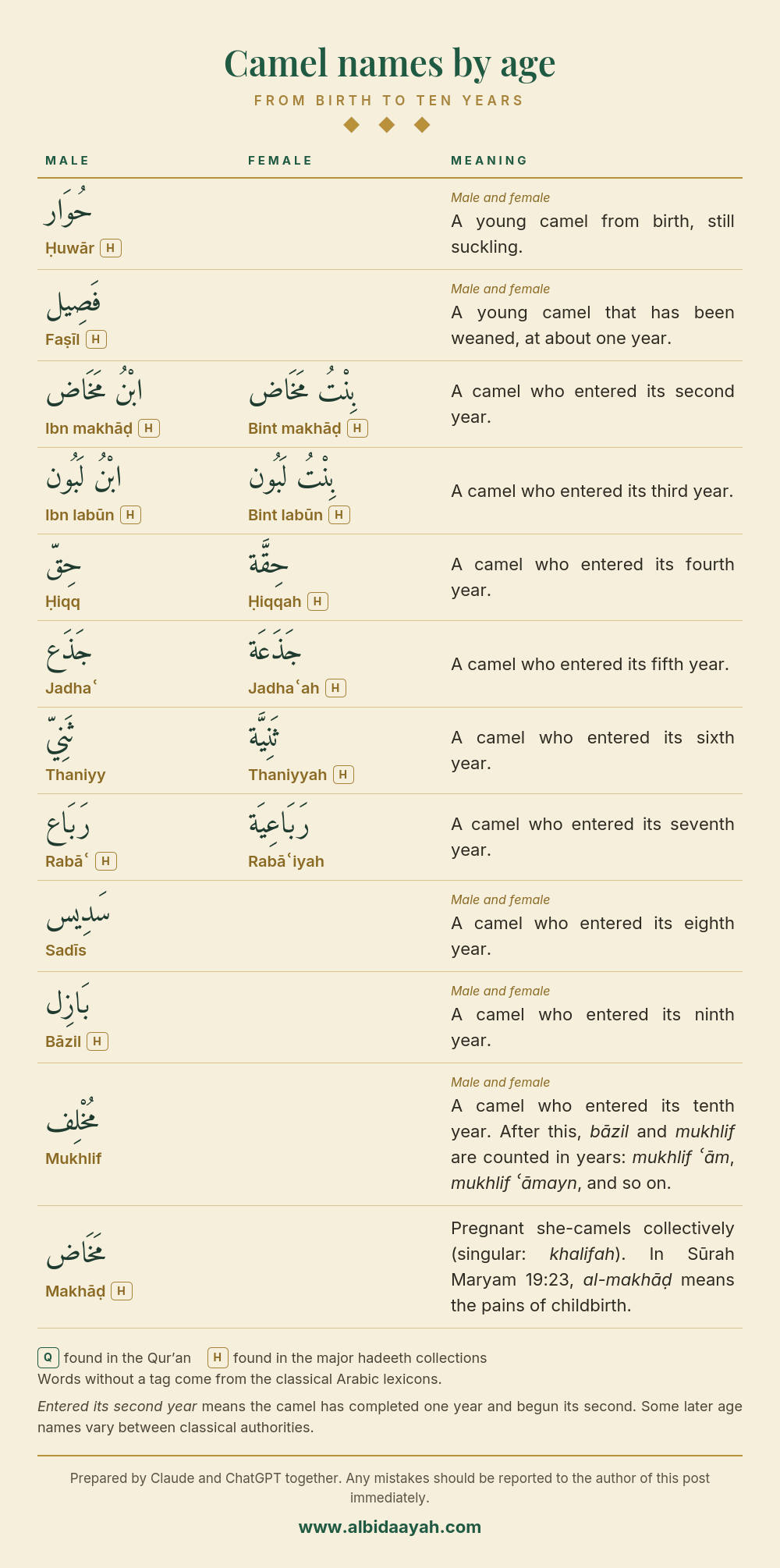
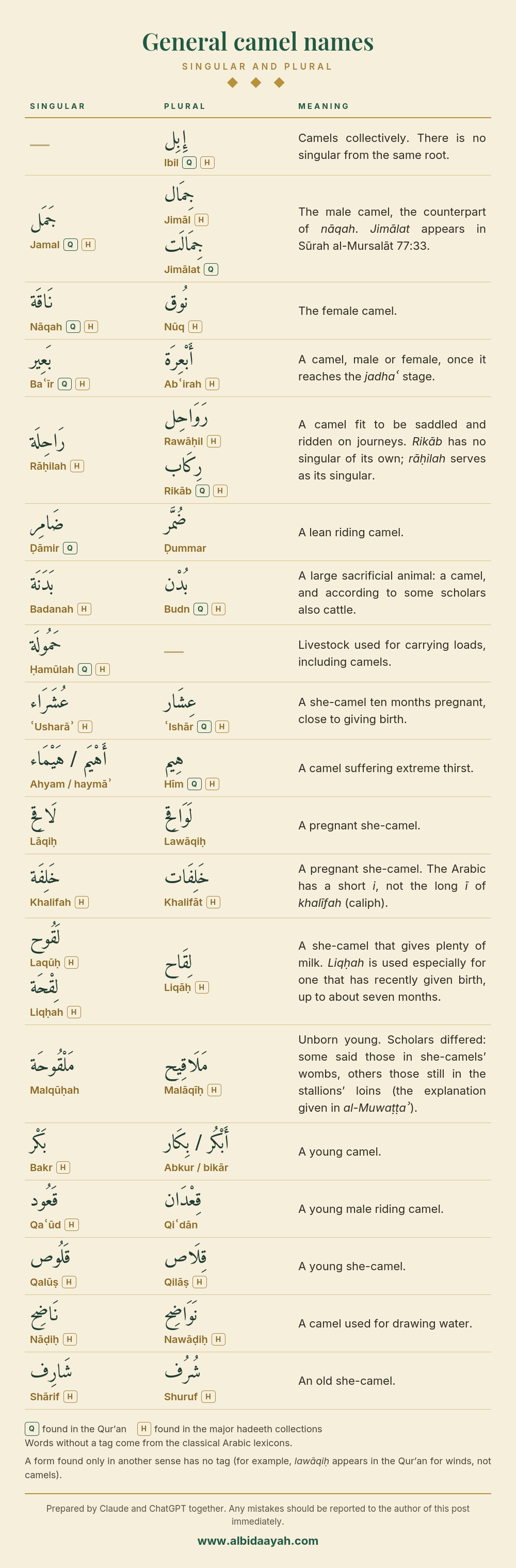
They had even more names for camels (too much love?).
Camels are also frequently mentioned in the Seerah (life story) of the Prophet (sallallahu alaihi wasallam). Even the names of his camels were recorded: Al-Qaswaa (الْقَصْوَاء), Al-Adhbaa (الْعَضْبَاء) and Al-Jadaa (الْجَدْعَاء) – though some scholars say these were all names of the same camel.
Camels in the UAE
Camels have remained a huge part of life in the Arabian Peninsula since the Prophet’s (sallallahu alaihi wasallam) time. In the UAE, camels were intricately tied to Emirati culture – and still are.
The UAE is full of camels and camel-related things. When I was younger, we used to always do some camel spotting whilst going between Dubai and Abu Dhabi. We would see camels bimbling around and get very excited. They can still be seen in the deserts, but as I am usually the one driving, I miss seeing them most of the time.
Both camel farms and camel hospitals can be found in the UAE. Until fairly recently, Dubai had a dedicated camel museum, but not anymore. To quote Dubai Culture (I asked them directly): “The history, anatomy, and cultural significance of camels are now integrated into the larger curated exhibitions within the Al Shindagha Museum complex (specifically under the Living off the Sea and Land themes).” Other museums across the UAE also have camel exhibits because, well, Arabs and camels, you know?
You can feed camels in this country and ride them in many places. I’ve fed camels multiple times (and also got bitten once). I also got to pet an adorable baby camel once, who looked so sad when we left.
Non-Arab camels
Due to my background, I used to always believe that camels were the most Arabian thing around (the dromedary is also known as the Arabian camel) until I found pictures and videos of them living outside Arabia. I was stunned. My Arab camels in non-Arab lands? How was that even possible?
Dromedaries, which are one-humped camels that we have in the UAE, are native to Arabia (although some claim that they originated in Somalia – which is just across the Gulf of Aden). It seems that the ancestors of today’s non-Arab dromedaries were actually imported from Arab lands and remained there.
Australia was one of the places that took in camels from countries that had imported the camel (and from other places as well), and well, due to its nice big desert, it has the largest population of feral dromedaries in the world. [Feral because the camels were domesticated and then released or escaped.]
And here we all thought that Australia was full of koalas and kangaroos.
It turns out that Australia actually sells camels to the UAE . At least this way, some of the non-Arab camels will become Arab like their ancestors. Question: How do we Arabise all the other remaining non-Arab camels? Just wondering.
Types of camels
A camel’s hump is a store of fat that the camel burns for energy when food is scarce. Dromedaries (our camels) have one hump. They were domesticated thousands of years ago, and their wild ancestors have since died out.
Bactrian camels have two and are native to parts of Central Asia. They were domesticated too, though a wild Bactrian species still exists (completely separate from the domestic ones).
Bactrians have shaggier coats than dromedaries and are stockier. Interestingly enough, these camels excel in cold environments – a direct contrast to dromedaries, which excel in hot environments.
The coats and humps aren’t the whole difference. Bactrians’ feet are more suited for rocky terrain and snow, whereas dromedaries’ feet suit the desert.
When I first came across a video of a Bactrian, I thought it looked like a cross between a sheep and a camel, so I nicknamed them “shamels”, only to recently find that someone who had the exact same thought must have added this word to Urban Dictionary. Oh well. Now we need to get it into Oxford, I guess.
Pondering over the creation of the camel
Many of us have seen countless camels, but have we pondered over how special they are?
Allah says:
أَفَلَا يَنظُرُونَ إِلَى الْإِبِلِ كَيْفَ خُلِقَتْ
Do they not look at the camels, how they are created? [Surah Al-Ghaashiyah (88) : 17]
Al-Qurtubi (rahimahullah) states in his explanation of this ayah:
“The commentators said: When Allah, Mighty and Majestic, mentioned the affairs of the inhabitants of the two abodes [Paradise and Hellfire], the disbelievers were astonished by this. They therefore rejected it and denied it. So Allah reminded them of His handiwork and power, and that He is capable of all things, just as He created the animals, the heavens and the earth.
He then mentioned the camels first because they were numerous among the Arabs, whereas they had not seen elephants. Thus, He, Glorified is He, drew their attention to a tremendous example of His creation that He had made subservient to a child. A child can lead a camel, make it kneel, cause it to rise, and load heavy burdens onto it while it is kneeling. It then rises carrying its heavy load. This is not found in any other animal besides it.
Thus, He showed them a magnificent creature of His creation that had been subjugated to a small one of His creation, thereby directing them to His Oneness and the greatness of His power.
It is reported from one of the wise men that he was told about the camel and the remarkable nature of its creation. Having grown up in a land where there were no camels, he reflected and then said: “They are likely to have long necks.”
When Allah intended camels to serve as the ships of the land, He made them capable of enduring thirst to such an extent that the interval between their drinks could reach ten days or more. He also made them graze on every kind of vegetation growing in the wilderness and desolate expanses, including plants that other livestock would not graze upon.”
He also stated:
“Al-Mawardi said: There are two interpretations of al-ibil. The first, and the more apparent and widely known, is that it refers to camels among livestock. The second is that it refers to clouds.
If clouds are intended, then this is because of the signs they contain that point to Allah’s power, as well as the benefits they provide universally to all His creation.
If camels among livestock are intended, then this is because camels combine more benefits than other animals, since the categories of animals are four: the animal kept for milk (ḥalūbah), the mount (rakūbah), the animal for eating (akūlah), and the beast of burden (ḥamūlah). Camels combine all four of these qualities. Their benefit is therefore more comprehensive, and the manifestation of Allah’s power in them is more complete.
Al-Hasan said: “Allah singled them out for mention because they eat date stones and al-qatt [dried alfalfa fodder], yet produce milk.”
Al-Hasan was also asked about them when someone remarked: “The elephant is more remarkable!” He replied: “The Arabs were unfamiliar with elephants. Moreover, it is a swine: its meat is not eaten, its back is not ridden, and its milk is not drawn.”
Shurayh would say: “Come, let us go out to the camel market [al-Kunāsah] so that we may look at how the camels were created.””
[Note: This was translated with the help of ChatGPT and Claude. I compared their translations to the Arabic and they looked okay. I then got them to check each other’s translations and then got the better parts combined. If there are issues with the translation, please let me know.]
Not the sweetest of animals
Camels are fascinating – but they aren’t exactly the sweetest animals, which might be one reason we are not permitted to pray in their pens.
عَنْ عَبْدِ اللَّهِ بْنِ مُغَفَّلٍ الْمُزَنِيِّ، قَالَ قَالَ النَّبِيُّ صلى الله عليه وسلم : صَلُّوا فِي مَرَابِضِ الْغَنَمِ وَلاَ تُصَلُّوا فِي أَعْطَانِ الإِبِلِ فَإِنَّهَا خُلِقَتْ مِنَ الشَّيَاطِينِ
It was narrated that Abdullah bin Mughaffal Al-Muzani (radiallahu anhu) said: “The Prophet (sallallahu alaihi wasallam) said: ‘Perform prayer in the sheep’s resting-places and do not perform prayer in the camels’ resting-places, for they were created from the devils.'” [Sunan Ibn Majah, Hadeeth No. 769. Graded “sahih” (authentic) by Al-Albani.]
It’s not just the camels. Some camel owners also have qualities that one could do without.
عَنْ أَبِي هُرَيْرَةَ ـ رضى الله عنه ـ عَنِ النَّبِيِّ صلى الله عليه وسلم قَال: أَتَاكُمْ أَهْلُ الْيَمَنِ، هُمْ أَرَقُّ أَفْئِدَةً وَأَلْيَنُ قُلُوبًا، الإِيمَانُ يَمَانٍ وَالْحِكْمَةُ يَمَانِيَةٌ، وَالْفَخْرُ وَالْخُيَلاَءُ فِي أَصْحَابِ الإِبِلِ، وَالسَّكِينَةُ وَالْوَقَارُ فِي أَهْلِ الْغَنَمِ
Narrated Abu Hurairah (radiallahu anhu): The Prophet (sallallahu alaihi wasallam) said, “The people of Yemen have come to you and they are more gentle and soft-hearted. Belief is Yemenite and Wisdom is Yemenite, while pride and haughtiness are the qualities of the owners of camels (i.e. bedouins). Calmness and solemnity are the characters of the owners of sheep.” [Sahih Al-Bukhari, Volume 5, Hadeeth No. 671]
Guess which group of people tended sheep?
عَنْ أَبِي سَلَمَةَ بْنِ عَبْدِ الرَّحْمَنِ، أَنَّ جَابِرَ بْنَ عَبْدِ اللَّهِ ـ رضى الله عنهما ـ قَالَ كُنَّا مَعَ رَسُولِ اللَّهِ صلى الله عليه وسلم نَجْنِي الْكَبَاثَ، وَإِنَّ رَسُولَ اللَّهِ صلى الله عليه وسلم قَالَ : عَلَيْكُمْ بِالأَسْوَدِ مِنْهُ، فَإِنَّهُ أَطْيَبُهُ . قَالُوا أَكُنْتَ تَرْعَى الْغَنَمَ قَالَ : وَهَلْ مِنْ نَبِيٍّ إِلاَّ وَقَدْ رَعَاهَا
Narrated Abu Salamah bin Abdur Rahman that Jabir bin Abdullah (radiallahu anhuma) said: We were with Allah’s Messenger (sallallahu alaihi wasallam) picking the fruits of the Arak trees, and Allah’s Messenger (sallallahu alaihi wasallam) said, “Pick the black fruit, for it is the best.” The companions asked, “Were you a shepherd?” He replied, “There was no prophet who was not a shepherd.” [Sahih Al-Bukhari, Volume 4, Hadeeth No. 618]
Nowadays, people might think of shepherding as a little thing, but this act was a training for the Prophets (alaihimissalaam) as mentioned by the people of knowledge.
Paying zakaah on camels and treating them well
Sheep owners and camel owners have one thing in common though – both groups have to pay the zakaah due on their animals (if they meet the required conditions), otherwise a heavy punishment awaits.
The full hadeeth is long (and is visually explained in this article of mine). Here’s the part about camels and sheep:
قِيلَ يَا رَسُولَ اللَّهِ فَالإِبِلُ قَالَ : وَلاَ صَاحِبُ إِبِلٍ لاَ يُؤَدِّي مِنْهَا حَقَّهَا وَمِنْ حَقِّهَا حَلَبُهَا يَوْمَ وِرْدِهَا إِلاَّ إِذَا كَانَ يَوْمُ الْقِيَامَةِ بُطِحَ لَهَا بِقَاعٍ قَرْقَرٍ أَوْفَرَ مَا كَانَتْ لاَ يَفْقِدُ مِنَهَا فَصِيلاً وَاحِدًا تَطَؤُهُ بِأَخْفَافِهَا وَتَعَضُّهُ بِأَفْوَاهِهَا كُلَّمَا مَرَّ عَلَيْهِ أُولاَهَا رُدَّ عَلَيْهِ أُخْرَاهَا فِي يَوْمٍ كَانَ مِقْدَارُهُ خَمْسِينَ أَلْفَ سَنَةٍ حَتَّى يُقْضَى بَيْنَ الْعِبَادِ فَيُرَى سَبِيلُهُ إِمَّا إِلَى الْجَنَّةِ وَإِمَّا إِلَى النَّارِ . قِيلَ يَا رَسُولَ اللَّهِ فَالْبَقَرُ وَالْغَنَمُ قَالَ : وَلاَ صَاحِبُ بَقَرٍ وَلاَ غَنَمٍ لاَ يُؤَدِّي مِنْهَا حَقَّهَا إِلاَّ إِذَا كَانَ يَوْمُ الْقِيَامَةِ بُطِحَ لَهَا بِقَاعٍ قَرْقَرٍ لاَ يَفْقِدُ مِنْهَا شَيْئًا لَيْسَ فِيهَا عَقْصَاءُ وَلاَ جَلْحَاءُ وَلاَ عَضْبَاءُ تَنْطِحُهُ بِقُرُونِهَا وَتَطَؤُهُ بِأَظْلاَفِهَا كُلَّمَا مَرَّ عَلَيْهِ أُولاَهَا رُدَّ عَلَيْهِ أُخْرَاهَا فِي يَوْمٍ كَانَ مِقْدَارُهُ خَمْسِينَ أَلْفَ سَنَةٍ حَتَّى يُقْضَى بَيْنَ الْعِبَادِ فَيُرَى سَبِيلُهُ إِمَّا إِلَى الْجَنَّةِ وَإِمَّا إِلَى النَّارِ
It was asked, “O Messenger of Allah, how about someone who owns camels and does not pay what is due on him (i.e., their zakaah)?” He (sallallahu alaihi wasallam) replied, “In the same way the owner of camels who does not discharge what is due in respect of them – and their due includes their milking on the day when they are taken to water – will be thrown on his face or on his back in a vast desert plain on the Day of Resurrection and they will trample upon him with their hoofs and bite him with their teeth. As often as the first of them passes him, the last of them will be made to return during a day the measure whereof will be fifty thousand years, until Judgement is pronounced among (Allah’s) slaves, he will be shown his final abode either to Paradise or to Hell.”
It was (again) asked: “O Messenger of Allah, what about cows (cattle) and sheep?” He (sallallahu alaihi wasallam) said, “If anyone who possesses cattle and sheep and does not pay what is due on them, on the Day of Resurrection, he will be thrown on his face in a vast plain desert. He will find none of the animals missing with twisted horns, without horns or with a broken horn, and they will gore him with their horns and trample upon him with their hoofs. As often as the first of them passes him, the last of them will be made to return to him during a day the measure whereof will be fifty thousand years, until Judgement is pronounced among (Allah’s) slaves; and he will be shown his final abode either to Paradise or to Hell.”
[Sahih Muslim, Hadeeth No. 2161. You can read the whole hadeeth here.]
This hadeeth mentions milking camels on the day they are taken to water. Shaikh Ibn Baz (rahimahullah) stated that the milk was to be given to the poor who were around the camel.
Camel owners also need to make sure not to overburden camels or keep them hungry.
عَنْ عَبْدِ اللَّهِ بْنِ جَعْفَرٍ، قَالَ : أَرْدَفَنِي رَسُولُ اللَّهِ صلى الله عليه وسلم خَلْفَهُ ذَاتَ يَوْمٍ فَأَسَرَّ إِلَىَّ حَدِيثًا لاَ أُحَدِّثُ بِهِ أَحَدًا مِنَ النَّاسِ، وَكَانَ أَحَبُّ مَا اسْتَتَرَ بِهِ رَسُولُ اللَّهِ صلى الله عليه وسلم لِحَاجَتِهِ هَدَفًا أَوْ حَائِشَ نَخْلٍ . قَالَ : فَدَخَلَ حَائِطًا لِرَجُلٍ مِنَ الأَنْصَارِ فَإِذَا جَمَلٌ فَلَمَّا رَأَى النَّبِيَّ صلى الله عليه وسلم حَنَّ وَذَرَفَتْ عَيْنَاهُ، فَأَتَاهُ النَّبِيُّ صلى الله عليه وسلم فَمَسَحَ ذِفْرَاهُ فَسَكَتَ، فَقَالَ : مَنْ رَبُّ هَذَا الْجَمَلِ، لِمَنْ هَذَا الْجَمَلُ . فَجَاءَ فَتًى مِنَ الأَنْصَارِ فَقَالَ : لِي يَا رَسُولَ اللَّهِ . فَقَالَ : ” أَفَلاَ تَتَّقِي اللَّهَ فِي هَذِهِ الْبَهِيمَةِ الَّتِي مَلَّكَكَ اللَّهُ إِيَّاهَا، فَإِنَّهُ شَكَى إِلَىَّ أَنَّكَ تُجِيعُهُ وَتُدْئِبُهُ
Abdullah bin Jafar (radiallahu anhuma) said “The Messenger of Allah (sallallahu alaihi wasallam) seated me behind him (on his ride) one day, and told me secretly a thing asking me not to tell it to anyone. The place for easing dearer to the Messenger of Allah (sallallahu alaihi wasallam) was a mound or host of palm trees by which he could conceal himself. He entered the garden of a man from the Ansar. All of a sudden when a camel saw the Prophet (sallallahu alaihi wasallam) it wept tenderly producing yearning sound and its eyes flowed. The Prophet (sallallahu alaihi wasallam) came to it and wiped the temple of its head. So it kept silence. He then said “Who is the master of this camel? Whose camel is this?” A young man from the Ansar came and said “This is mine, Messenger of Allah.” He said “Don’t you fear Allah about this beast which Allah has given in your possession. It has complained to me that you keep it hungry and load it heavily which fatigues it.” [Sunan Abee Dawood, Hadeeth No. 2549. Graded “sahih” (authentic) by Al-Albani.]
Do we still have camel owners, one may wonder? Yes, we do (at least in this part of the world).
Some of those who used to herd camels have upgraded to other things though. In the famous hadeeth of Jibreel (alaihissalaam), one of the signs of the Last Day is mentioned. Some of the narrations mentioned shepherds whilst others mentioned camel herders. Here is the relevant portion of the hadeeth.
قَالَ مَتَى السَّاعَةُ قَالَ : مَا الْمَسْئُولُ عَنْهَا بِأَعْلَمَ مِنَ السَّائِلِ، وَسَأُخْبِرُكَ عَنْ أَشْرَاطِهَا إِذَا وَلَدَتِ الأَمَةُ رَبَّهَا، وَإِذَا تَطَاوَلَ رُعَاةُ الإِبِلِ الْبُهْمُ فِي الْبُنْيَانِ
“Then he (Jibreel) further asked, “When will the Hour be established?” Allah’s Messenger (sallallahu alaihi wasallam) replied, “The answerer has no better knowledge than the questioner. But I will inform you about its portents. When a slave (lady) gives birth to her master and when the shepherds of black camels start boasting and competing with others in the construction of higher buildings.” [Sahih Al-Bukhari, Volume 1, Hadeeth No. 47. You can read the whole hadeeth here. Note: The numbering in the link says 48 but my book said 47.]
Camel markets
Camel markets still exist in Arabia. There is only one traditional camel market left in the UAE – in Al Ain. However, there is a new one coming up in Al Dhaid, Sharjah.
Here’s a look at the Al Ain Camel Market. I have not been to it but it’s full of dromedaries (and men).
عَن أَبي هُرَيْرَة ـ رضى الله عنه ـ عَنِ النَّبِيِّ صلى الله عليه وسلم : لاَ تُصَرُّوا الإِبِلَ وَالْغَنَمَ، فَمَنِ ابْتَاعَهَا بَعْدُ فَإِنَّهُ بِخَيْرِ النَّظَرَيْنِ بَعْدَ أَنْ يَحْتَلِبَهَا إِنْ شَاءَ أَمْسَكَ، وَإِنْ شَاءَ رَدَّهَا وَصَاعَ تَمْرٍ
Narrated Abu Hurairah (radiallahu anhu): The Prophet (sallallahu alaihi wasallam) said, “Don’t keep camels and sheep unmilked for a long time, for whoever buys such an animal has the option to milk it and then either to keep it or return it to the owner along with one Saa of dates.” [Sahih Al-Bukhari, Volume 3, Hadeeth No. 358]
One might ask: Why go to a camel market? Why not just take a camel from the desert instead?
You cannot do that because every camel in the UAE is owned by someone (yes, really). Also, according to the Shariah, we are not allowed to take lost camels.
عَنْ زَيْدِ بْنِ خَالِدٍ ـ رضى الله عنه ـ أَنَّ أَعْرَابِيًّا، سَأَلَ النَّبِيَّ صلى الله عليه وسلم عَنِ اللُّقَطَةِ قَالَ : عَرِّفْهَا سَنَةً، فَإِنْ جَاءَ أَحَدٌ يُخْبِرُكَ بِعِفَاصِهَا وَوِكَائِهَا، وَإِلاَّ فَاسْتَنْفِقْ بِهَا . وَسَأَلَهُ عَنْ ضَالَّةِ الإِبِلِ فَتَمَعَّرَ وَجْهُهُ، قَالَ : مَا لَكَ وَلَهَا مَعَهَا سِقَاؤُهَا وَحِذَاؤُهَا، تَرِدُ الْمَاءَ وَتَأْكُلُ الشَّجَرَ، دَعْهَا حَتَّى يَجِدَهَا رَبُّهَا . وَسَأَلَهُ عَنْ ضَالَّةِ الْغَنَمِ. فَقَالَ : هِيَ لَكَ أَوْ لأَخِيكَ، أَوْ لِلذِّئْبِ
Narrated Zaid bin Khalid (radiallahu anhu): A bedouin asked the Prophet (sallallahu alaihi wasallam) about the Luqata (lost things found by someone). The Prophet (sallallahu alaihi wasallam) said, “Make public announcement about it for one year and if then somebody comes and describes the container of the Luqata and the string it was tied with, (give it to him); otherwise, spend it.” He then asked the Prophet (sallallahu alaihi wasallam) about a lost camel. The face of the Prophet (sallallahu alaihi wasallam) became red and he said, “You have no concern with it as it has its water reservoir and feet and it will reach water and drink and eat trees. Leave it till its owner finds it.” He then asked the Prophet (sallallahu alaihi wasallam) about a lost sheep. The Prophet (sallallahu alaihi wasallam) said, “It is for you, for your brother, or for the wolf.” [Sahih Al-Bukhari, Volume 3, Hadeeth No. 618]
Camel beauty pageant
Not all camels look the same as they come in different colours. For Arabs, red camels were a prized possession.
عَنْ سَهْلٍ، – يَعْنِي ابْنَ سَعْدٍ – عَنِ النَّبِيِّ صلى الله عليه وسلم قَالَ : وَاللَّهِ لأَنْ يُهْدَى بِهُدَاكَ رَجْلٌ وَاحِدٌ خَيْرٌ لَكَ مِنْ حُمْرِ النَّعَمِ
It was narrated from Sahl ibn Saad (radiallahu anhu) that the Prophet (sallallahu alaihi wasallam) said: “By Allah, if Allah were to guide one man at your hand, it would be better for you than red camels.” [Sunan Abee Dawood, Hadeeth No. 3661. Graded “sahih” (authentic) by Al-Albani.]
Remember I mentioned all the names that Arabs gave to camels at the beginning of the post? Well, there’s more where that came from. They also had names for camels based on colour.
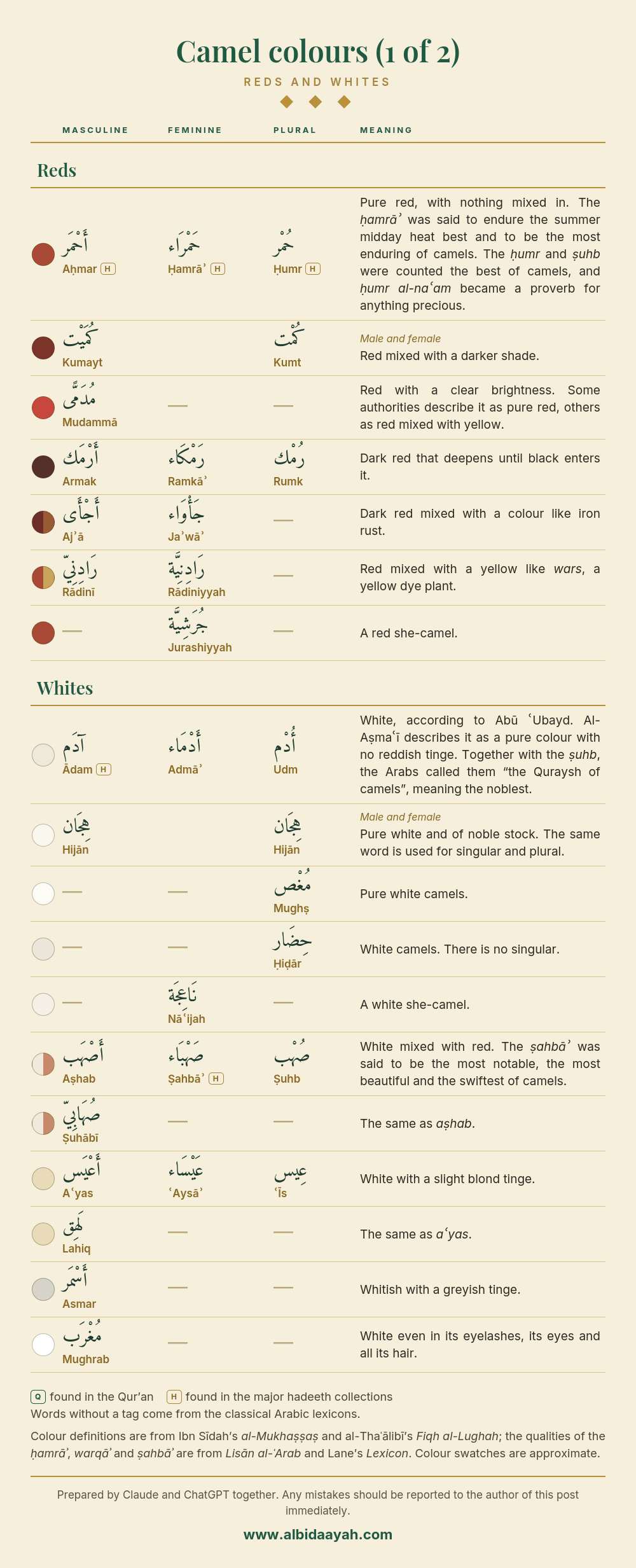
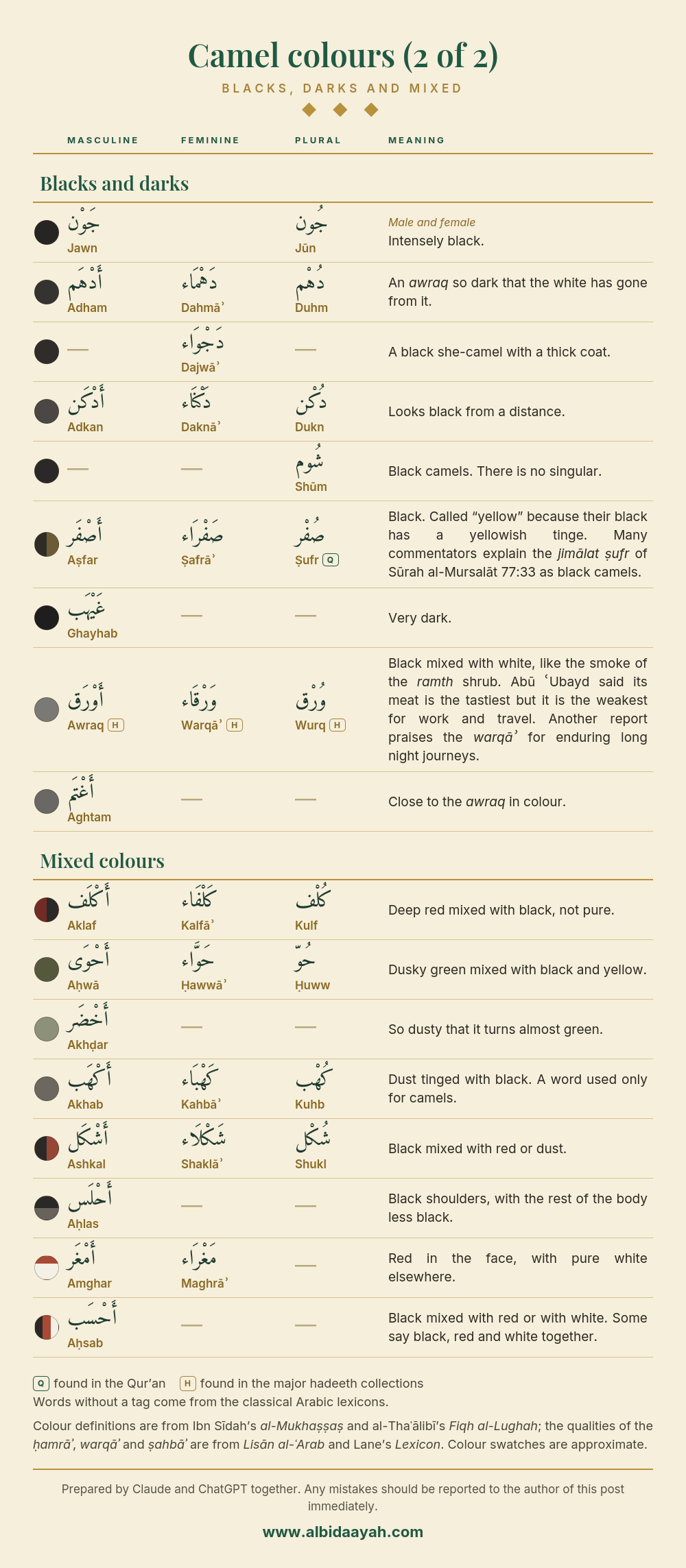
Some camels are also more good-looking than others. Some are so beautiful that they win camel beauty pageants. I know this sounds like a bizarre concept. Just remember that Arabs love their camels (a bit too much, I feel, but let’s not go there).
Camel racing
A lot of people buy camels for racing. Here in the UAE, we have multiple camel racing tracks with races taking place in winter.
In the past, young boys used to ride the camels (because they were lighter) but that was banned in 2005. Now robot jockeys are used.
Here’s a wonderful little video explaining camel racing:
Back in the day, horse racing was shown on the English channel and camel racing was shown on the Arabic one. Last year, I tried to go to a camel race early in the morning, but I could not find the entrance to the place (Google Maps is useless sometimes).
Fascinatingly enough, both types of races (camel and horse) are mentioned in the following hadeeth:
عَنْ أَبِي هُرَيْرَةَ، قَالَ قَالَ رَسُولُ اللَّهِ صلى الله عليه وسلم : لاَ سَبْقَ إِلاَّ فِي خُفٍّ أَوْ فِي حَافِرٍ أَوْ نَصْلٍ
Narrated Abu Hurairah (radiallahu anhu): The Prophet (sallallahu alaihi wasallam) said: “Prizes are only allowed in races between camels, horses and shooting arrows.” [Sunan Abee Dawood, Hadeeth No. 2574. Graded “sahih” (authentic) by Al-Albani.]
The scholars mentioned that these three were singled out because they were used in warfare.
[Note: The hadeeth itself requires a long time to explain. So whoever is interested should ask a person of knowledge about it.]
Camel meat
Camels aren’t just purchased to race – they can also be purchased to slaughter, especially for Hajj or Udhiyah. One camel suffices seven people.
عَنْ جَابِرِ بْنِ عَبْدِ اللَّهِ، قَالَ حَجَجْنَا مَعَ رَسُولِ اللَّهِ صلى الله عليه وسلم فَنَحَرْنَا الْبَعِيرَ عَنْ سَبْعَةٍ وَالْبَقَرَةَ عَنْ سَبْعَةٍ
Jabir bin Abdullah (radiallahu anhu) reported: We performed Hajj along with Allah’s Messenger (sallallahu alaihi wasallam), and we sacrificed a camel on behalf of seven people, and a cow on behalf of seven people. [Sahih Muslim, Hadeeth No. 3026]
Others might buy camels just to slaughter them for the meat, not for Hajj or Udhiyah. In the UAE, camel meat can be ordered online. I’ve not done that yet and have only had the chance to taste the meat once.
There is a specific ruling connected to camel meat that everyone should be aware of.
عَنْ جَابِرِ بْنِ سَمُرَةَ، أَنَّ رَجُلاً، سَأَلَ رَسُولَ اللَّهِ صلى الله عليه وسلم أَأَتَوَضَّأُ مِنْ لُحُومِ الْغَنَمِ قَالَ : إِنْ شِئْتَ فَتَوَضَّأْ وَإِنْ شِئْتَ فَلاَ تَوَضَّأْ . قَالَ أَتَوَضَّأُ مِنْ لُحُومِ الإِبِلِ قَالَ : نَعَمْ فَتَوَضَّأْ مِنْ لُحُومِ الإِبِلِ . قَالَ أُصَلِّي فِي مَرَابِضِ الْغَنَمِ قَالَ : نَعَمْ . قَالَ أُصَلِّي فِي مَبَارِكِ الإِبِلِ قَالَ : لاَ
Jabir bin Samurah (radiallahu anhu) reported: A man asked the Messenger of Allah (sallallahu alaihi wasallam) whether he should perform ablution after (eating) mutton. He (sallallahu alaihi wasallam) said: Perform ablution if you so desire, and if you do not wish, do not perform it. He (again) asked: Should I perform ablution (after eating) camel’s flesh? He (sallallahu alaihi wasallam) said: Yes, perform ablution (after eating) camel’s flesh. He (again) said: May I say prayer in the sheepfolds? He (sallallahu alaihi wasallam) said: Yes. He (the narrator) again said: May I say prayer where camels lie down? He (sallallahu alaihi wasallam) said: No. [Sahih Muslim, Hadeeth No. 700]
The scholars differed as to whether eating camel meat broke one’s wudhu. One group said it did whereas the second group said it did not. It would be better to err on the side of caution and do wudhu after eating camel meat – especially as the hadeeth instructs it.
Camel milk and camel urine
Camels are also purchased for their milk. Camel milk is sold in supermarkets here – sometimes in different flavours. Camel milk tastes different to cow milk. I used to like both a lot (prior to being diagnosed with dairy intolerance) but camel date milk and camel saffron milk were just too delicious.
We also have lots of other things made with camel milk here.
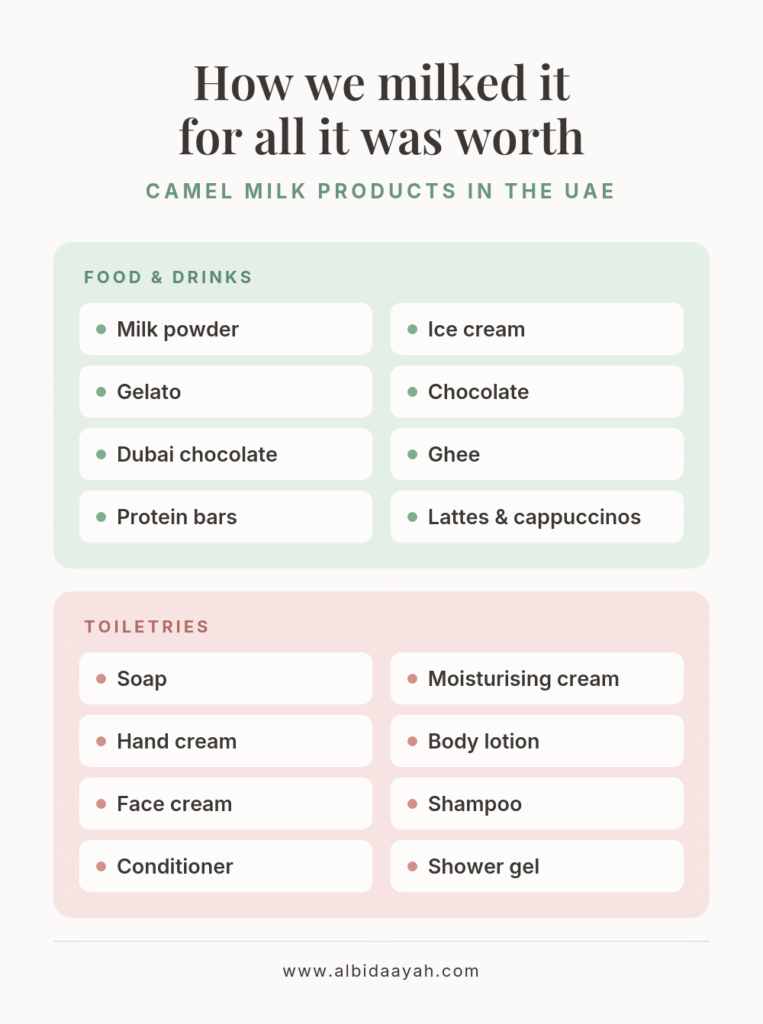
[Full disclosure: The idea for the pun came from Claude.]
Much of the above is made by Camelicious in Dubai, which has the largest camel dairy farm in the world. [And no, I do not work for them nor are they paying me commission for mentioning them in my post.]
Does one need to do wudhu again when drinking camel milk, one may ask? No, this ruling is just for the meat of a camel, not its milk.
Both camel milk and camel urine can be used as medicine.
عَنْ أَنَسِ بْنِ مَالِكٍ، قَالَ قَدِمَ أَعْرَابٌ مِنْ عُرَيْنَةَ إِلَى نَبِيِّ اللَّهِ صلى الله عليه وسلم فَأَسْلَمُوا فَاجْتَوَوُا الْمَدِينَةَ حَتَّى اصْفَرَّتْ أَلْوَانُهُمْ وَعَظُمَتْ بُطُونُهُمْ فَبَعَثَ بِهِمْ نَبِيُّ اللَّهِ صلى الله عليه وسلم إِلَى لِقَاحٍ لَهُ فَأَمَرَهُمْ أَنْ يَشْرَبُوا مِنْ أَلْبَانِهَا وَأَبْوَالِهَا حَتَّى صَحُّوا فَقَتَلُوا رُعَاتِهَا وَاسْتَاقُوا الإِبِلَ فَبَعَثَ نَبِيُّ اللَّهِ صلى الله عليه وسلم فِي طَلَبِهِمْ فَأُتِيَ بِهِمْ فَقَطَّعَ أَيْدِيَهُمْ وَأَرْجُلَهُمْ وَسَمَّرَ أَعْيُنَهُمْ . قَالَ أَمِيرُ الْمُؤْمِنِينَ عَبْدُ الْمَلِكِ لأَنَسٍ وَهُوَ يُحَدِّثُهُ هَذَا الْحَدِيثَ بِكُفْرٍ أَوْ بِذَنْبٍ قَالَ بِكُفْرٍ
It was narrated that Anas bin Malik (radiallahu anhu) said: “Some Bedouin from Uraynah came to the Prophet of Allah (sallallahu alaihi wasallam) and accepted Islam, but the climate of Al-Madinah did not suit them; their skin turned yellow and their bellies became swollen. The Prophet of Allah (sallallahu alaihi wasallam) sent them to some milk camels of his and told them to drink their milk and urine until they recovered. Then they killed their herdsmen and drove off the camels. The Prophet of Allah (sallallahu alaihi wasallam) sent (men) after them and they were brought back, then he had their hands and feet cut off, and their eyes were branded.” The Commander of the Believers, Abdul-Malik, said to Anas, when he was narrating this Hadith: “Was that (punishment) for Kufr (disbelief) or for sin?” He said: “For Kufr.” [Sunan An-Nasai, Hadeeth No. 4040. Al-Albani stated that it was “sahihul-isnad” (authentic chain of narrators).]
Camel milk has a lot of benefits.
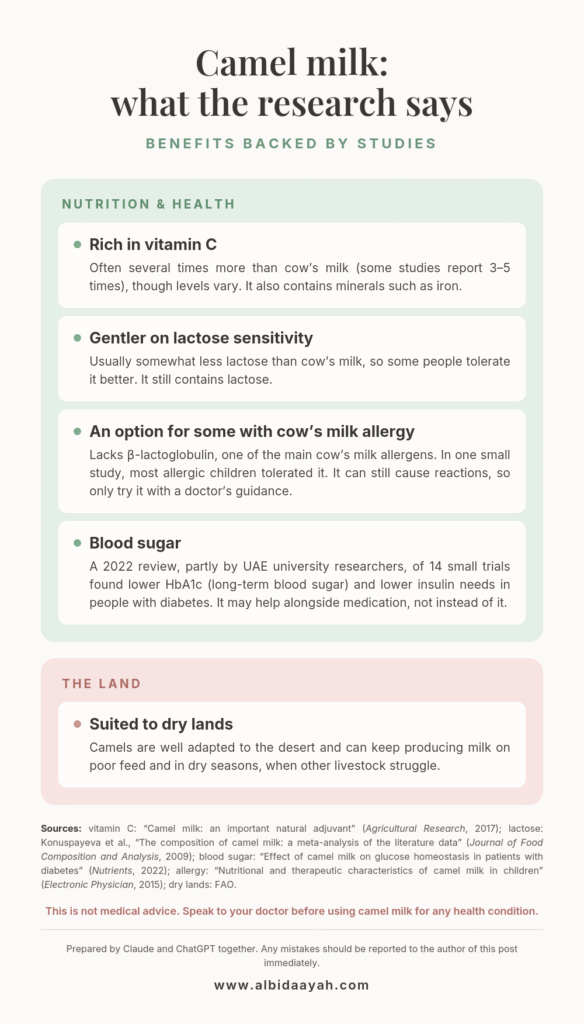
Years ago, one of my ex-classmates emailed me this story of her uncle who suffered from bone marrow cancer (I have lightly edited it for grammar):
“He then traveled to Yemen and there people advised him to take camel milk. So he drank it daily early morning for about a month. When he returned to London, and when the doctors diagnosed him, subhanallah, they were shocked to see that he was cured. Of course they asked what treatment he took in Yemen. He told them about the camel milk. They then advised him to continue with the same but he could not continue due to work and family. Anyway, he was okay for some time but as he could not continue the camel milk treatment, it came back again and so he passed away.”
I thought I would share this. Please do check with your doctors as this is one person’s story, not proof that camel milk could help with bone marrow cancer.
As for camel urine, it is a medicine, not for general consumption. Remember that this is from the Sunnah so we should not mock it. Before taking it, check with a doctor to see if camel urine is a cure for the disease in question.
How the camels made me realise the worth of the Arabian Peninsula
As you can see, the UAE really is full of camel-related stuff. Does it matter, though? To me, it does.
It was never difficult for me to visualise Islamic history because many of the things mentioned there were always in front of me – the desert, the camels, the palm trees, the dates, and the Arabs and their hospitality.
I always considered this a great blessing from Allah and used to wonder how people outside the Peninsula would envision the events of the past when they were not surrounded by the same things mentioned in it. The fact that things mentioned in the Sunnah, like camel milk, camel meat, camel racing, purchasing camels, etc., all have their place here made this part of the world more special to me.
I always considered the UAE to be my country – and the only country I had. However, nobody around me agreed and, in fact, went out of their way to mock me for my stance, simply because my passport was not from here, nor was my bloodline. It was too difficult for them to understand that I was born and raised here, and have spent my entire life here, so obviously it was the only land I had ever had.
This mockery has gone on for decades. Many of those who made fun of me had no problem referring to certain others as being from here, even though those people too had the same “no passport nor bloodline” problem as me.
When I was a young child, a close family member got upset because I said that I was from this country and retorted, “What if they throw you out?” That always made me worry about deportation, as I was not recognised as being from here on an official level.
When the 10-year visas came out, that was the first time I realised that I was a temporary resident of the place I had always been sure was home. That and the constant mockery made me start looking for other Muslim countries to move to in order to have stability (either citizenship or permanent residency) and a more Islamic life.
I started to wish that I had been born and raised in a country that gave citizenship. Even if I moved, I would never be seen as being from the new country, so I would always be landless in a way. However, I knew there had to be some wisdom behind it, so I tried to avoid thinking that way.
Whilst I was working on the article, I remembered how blessed I felt to live in a place that had some resemblance to the Prophet’s (sallallahu alaihi wasallam) time. I realised that maybe this was the wisdom of being born and raised in a place that nobody but me calls my country.
Alhamdulillah, that realisation made me so happy. I’m sharing it so that others in the Gulf in the exact same position can also feel grateful to Allah for the same reason, rather than feeling resentful for not having a passport (which does happen).
I also hope that people (from outside the Peninsula) who visit the UAE or the other Gulf lands take advantage of this aspect of the Peninsula. Rather than waste time in malls, try to do things that will bring you closer to the Seerah (life story of the Prophet (sallallahu alaihi wasallam)).
As for the permanent home, may Allah grant me and those like me a land that we can belong to one day – legally and emotionally. Even if we don’t get one, we need to remember that there is an everlasting home waiting for those who are obedient to Allah. Everyone who enters it will belong there. Nobody will be asked to leave, and there will be no mockery.
Earlier in the post, I had mentioned this ayah (verse):
أَفَلَا يَنظُرُونَ إِلَى الْإِبِلِ كَيْفَ خُلِقَتْ
Do they not look at the camels, how they are created? [Surah Al-Ghaashiyah (88) : 17]
Why were the camels mentioned here?
Imam Al-Baghawi (rahimahullah) states in his explanation of this ayah:
“The scholars of tafsīr said: When Allah, the Exalted, described in this sūrah what is in Paradise, the disbelievers were astonished by it and denied it. So Allah, the Exalted, reminded them of His handiwork and said: “Do they not look at the camels” [from among all the other animals], “how they were created?””
What precedes this ayah is a look at the delights of Paradise.
وُجُوهٌ يَوْمَئِذٍ نَّاعِمَةٌ
(Other) faces, that Day, will be joyful,
لِّسَعْيِهَا رَاضِيَةٌ
Glad with their endeavour (for their good deeds which they did in this world, along with the true Faith of Islamic Monotheism).
فِي جَنَّةٍ عَالِيَةٍ
In a lofty Paradise.
لَّا تَسْمَعُ فِيهَا لَاغِيَةً
Where they shall neither hear harmful speech nor falsehood,
فِيهَا عَيْنٌ جَارِيَةٌ
Therein will be a running spring,
فِيهَا سُرُرٌ مَّرْفُوعَةٌ
Therein will be thrones raised high,
وَأَكْوَابٌ مَّوْضُوعَةٌ
And cups set at hand.
وَنَمَارِقُ مَصْفُوفَةٌ
And cushions set in rows,
وَزَرَابِيُّ مَبْثُوثَةٌ
And rich carpets (all) spread out.
[Surah Al-Ghaashiyah (88) : 8 – 16]
This is my favourite description of Paradise in the Quran. The fact that camels are mentioned right after makes it more personal given that I live in a camel-filled country. Not everyone has the luxury of being able to see camels live in their land so that they can ponder over their creation.
So make sure to focus on reaching the eternal Abode of Peace, and not just a new country (if that’s what you want).
Whilst you are here though, take a look around you, appreciate all the things that remind you of the Seerah and increase in gratitude to Allah for granting you that opportunity.
And don’t forget to enjoy all the camel-related stuff because, well, our Arab side demands it, you know?
PS. If you want to visit cultural places in the UAE that remind you of the Seerah, Quran and Sunnah (like camel places, deserts, parks with different types of palm trees, Quran museums, etc.), I plan halal itineraries for a reasonable price. Women can email me at admin@dx3.me or leave a comment on this post.
PPS. Yes, ChatGPT can help you with your itineraries but in most cases (speaking as an AI consultant here), it can’t give you the depth a human can. It doesn’t understand what can affect the heart so its plan might not be one that brings you closer to Allah.
Discover more from Al Bidaayah
Subscribe to get the latest posts sent to your email.